
From Austrian Kipferl to Parisian Icon: The History of the Croissant
While widely recognized as the quintessential emblem of French gastronomic identity, the croissant's origins span centuries of European geopolitical struggle, Austrian royal marriages, and 19th-century Parisian baking ingenuity.
The Siege of Vienna & The Crescent Symbol
Popular culinary folklore frequently traces the crescent shape (*croissant* in French) to the Siege of Vienna in 1683. According to enduring legend, Ottoman Turkish forces attempted to breach the defensive city walls by digging subterranean tunnels under the fortifications. Viennese bakers working in underground cellars during the dead of night detected the sound of pickaxes and alerted the imperial defenders.
Following the defeat of the Ottoman army, the bakers were purportedly granted the royal privilege to bake a crescent-shaped celebratory yeast roll called the Kipferl (German for "crescent"), designed to playfully mimic the crescent on the Ottoman military banner.
While historical documentation proves that crescent-shaped bread existed in Austrian monasteries as early as the 12th century, the 1683 narrative firmly established the Kipferl as a cherished Viennese breakfast pastry. Crucially, however, the original Austrian Kipferl was not flaky puff pastry; it was a heavy, brioche-like enriched yeast roll.
August Zang & The Birth of Viennoiserie
The true birth of the croissant in Paris occurred in 1838 or 1839, when an Austrian artillery officer named August Zang founded the Boulangerie Viennoise at 92 Rue de Richelieu in Paris.
Zang imported Austrian patent ovens utilizing indirect steam injection and used finely ground Hungarian wheat flours. His Kipferl rolls became an overnight sensation among the Parisian upper classes, praised in contemporary newspapers by Alexandre Dumas and Théophile Gautier. Within years, French bakers across the capital began imitating Zang's recipes, creating a distinct new culinary category: Viennoiserie (meaning "things in the style of Vienna").
The Invention of Laminated Puff Pastry (*Pâte Feuilletée Levée*)
Until the dawn of the 20th century, croissants remained essentially enriched bread rolls. The revolutionary breakthrough occurred between 1900 and 1906, when Parisian bakers married Austrian brioche dough with the French classical method of feuilletage (puff pastry lamination, pioneered by Antonin Carême).
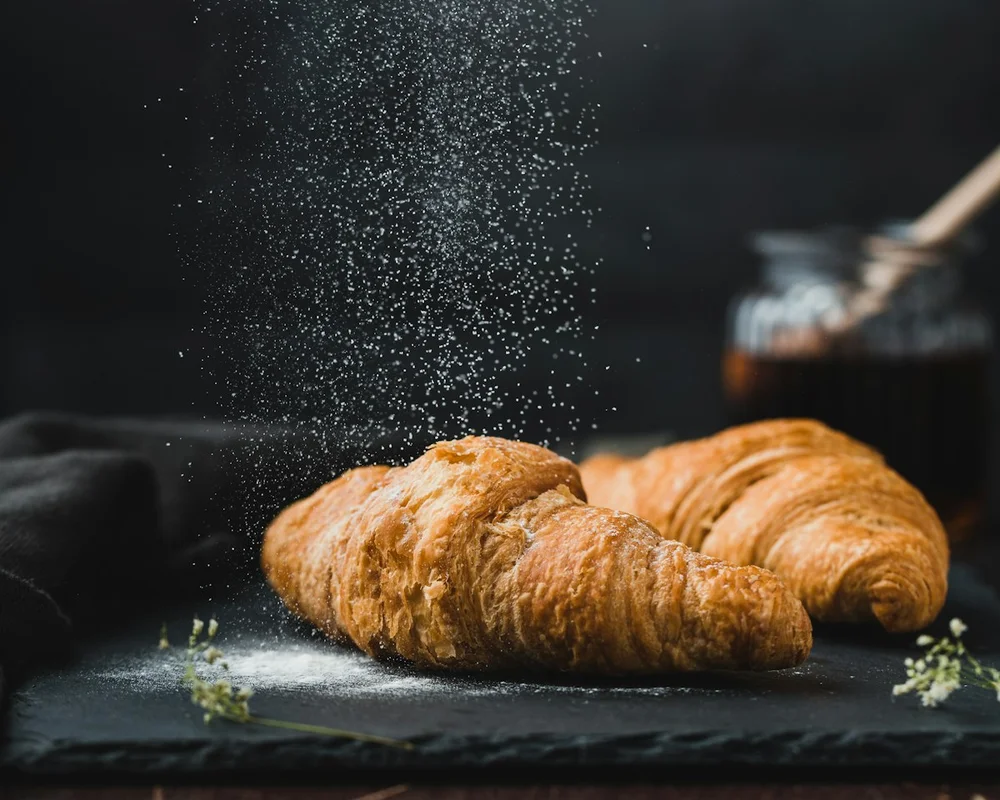
Instead of simply kneading butter into the flour, bakers rolled butter into a sheet, encased it in cold dough, and executed multiple turns (*tours*). When placed into high-heat ovens, the water in the butter flashed into steam, expanding the laminated dough into hundreds of paper-thin, crackling, buttery leaves.
This was the birth of the modern Croissant au Beurre—a pastry that belongs entirely to the artistry of Parisian baking.
The Renaissance at La Maison d'Isabelle
During the late 20th century, industrialization threatened the French croissant. Mass-produced frozen doughs (*croissants surgelés*) made with palm oil and margarine flooded Parisian cafes.
Artisanal bakeries like La Maison d'Isabelle led the revival of true French craft. By adhering strictly to Charentes-Poitou AOP cultured butter, certified organic flours, natural slow fermentation, and continuous on-site baking, artisans like Isabelle Leday preserved the integrity of this historic breakfast monument.